How to Prepare for the 2026 El Niño
What to stock, how to size backup power for your home, and what flood-prone and fire-prone regions should do differently - all before the winter peak.
This guide includes affiliate links to BLUETTI and Amazon. As an Amazon Associate we may earn from qualifying purchases, at no extra cost to you.
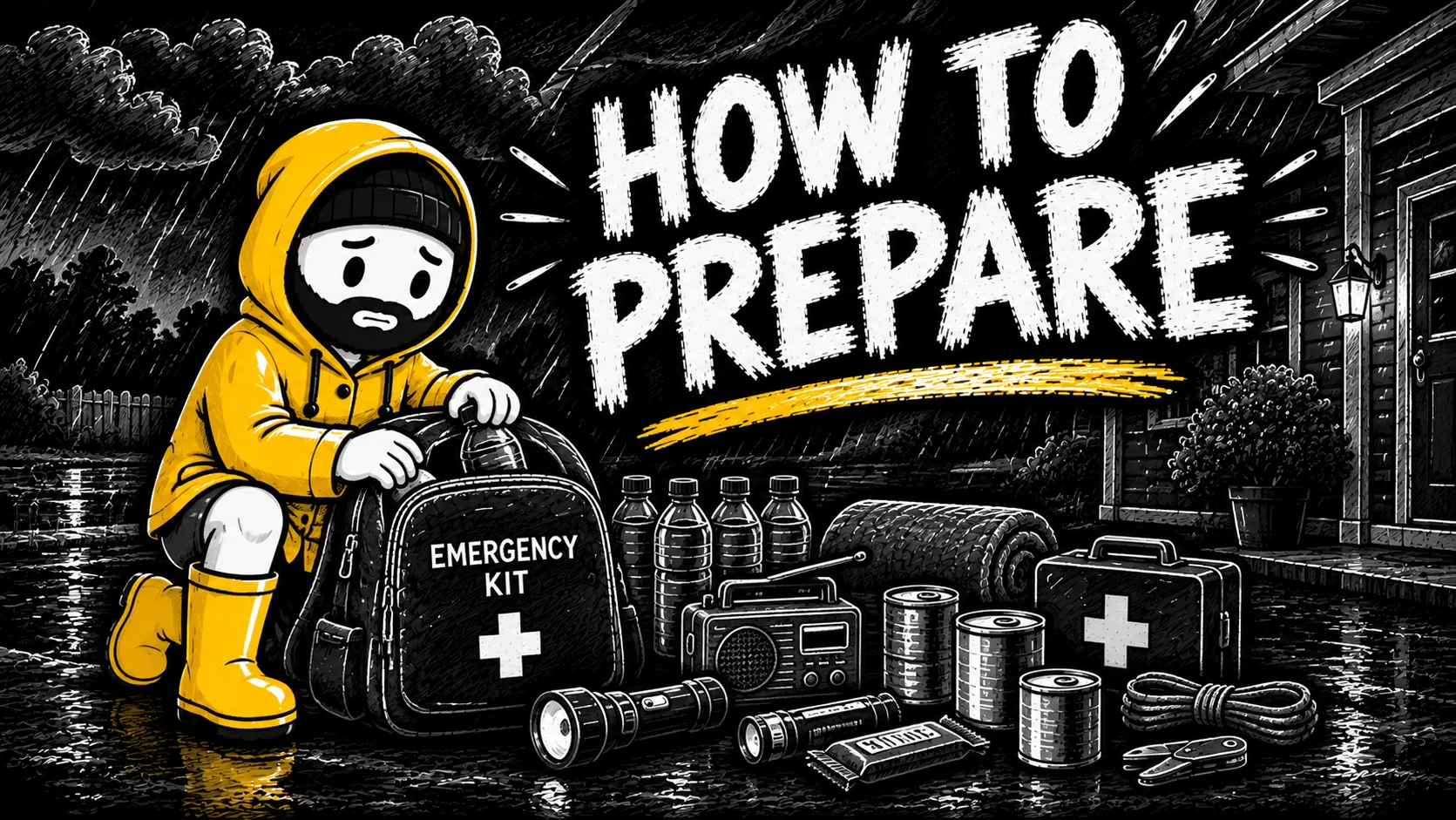
Start with your region, not the storm
El Niño does not bring one kind of winter to the whole country. It steers the Pacific storm track south, so California, the Southwest, Texas, the Gulf Coast and the Southeast tend to get a wetter, stormier season with more flooding, while the Pacific Northwest, the northern tier and the Great Lakes usually run milder and drier with thin snowpack and an earlier fire season. Those two futures call for different gear.
Two things are true almost everywhere, though. First, a stormier winter means more power outages, so backup power is the one purchase that pays off in every region. Second, the basics - water, food, light, first aid, a way to get alerts - are the same no matter where you live. This guide starts there, then splits by region. If you want the forecast behind all of this, the 2026 Super El Niño explainer covers it; to see which side of the split your city is on, check your location.
The basics every household needs
Emergency managers plan around three days of self-sufficiency, and two weeks is better if you have the space. The planning figure for water is one gallon per person per day for drinking and basic sanitation - count pets too. Food should be shelf-stable and need no cooking. Add a flashlight or lantern for every bedroom, a first-aid kit that is actually stocked, a week of any prescription medications, and copies of IDs, insurance policies and account numbers somewhere dry.
If you are starting from nothing, a ready-made 72-hour kit covers most of these gaps in one purchase, and you can top it up with the items below.
The one item people skip is a way to get warnings when the power and cell service are both down. A hand-crank NOAA weather radio does that with no battery to go flat, and a rechargeable lantern is far safer than candles in a house full of people moving around in the dark.
Backup power: how much do you actually need?
Power stations are sold on two numbers, and mixing them up is the most common sizing mistake. Watts is how much the unit can run at once. Watt-hours is how long it can run it. A unit rated 1,000W and 768Wh can power up to roughly 1,000 watts of devices at a time, and holds enough energy to supply 100 watts for about seven and a half hours, or 300 watts for about two and a half.
To size one, list what you truly need during an outage and add up the running wattage from each device's label. Some rough figures: charging a phone takes around 10 to 15 watt-hours, a Wi-Fi router draws about 10 watts, a CPAP roughly 30 to 60 watts without its humidifier, a laptop around 50 watts, and a full-size refrigerator 100 to 200 watts while the compressor runs, which works out to about 1 to 1.5 kilowatt-hours over a day because it cycles on and off. Multiply what you need by how many hours you want to cover, then buy the next size up.
Unlike a gas generator, a battery power station makes no exhaust, so it is safe to use inside an apartment or a closed-up house during a storm. That is the reason to choose one even if you own a generator: it is the unit you actually keep next to the fridge.
Phones, lights and a router for a few hours to a day
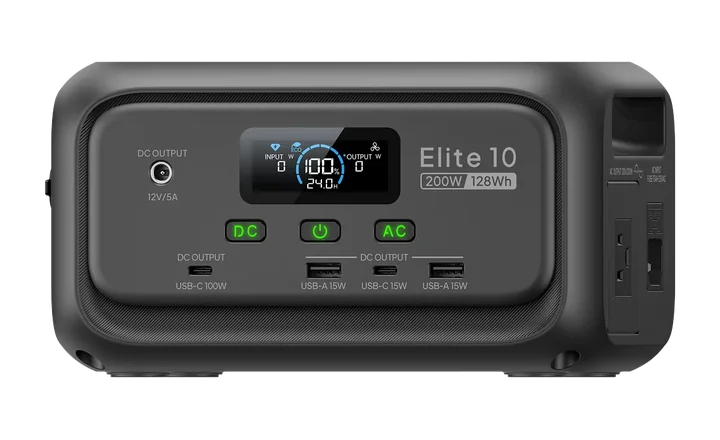
For most short outages you need very little: keep phones charged, a lantern lit and the internet up. A compact station covers that and fits in a closet or a car, and it is the sensible starting point if you are on a budget or in a small apartment. The Elite 10 Mini, at 200W and 128Wh, holds roughly eight phone charges or runs a Wi-Fi router for about half a day. It is not built to run a refrigerator.
A fridge, a CPAP and the essentials through a long outage
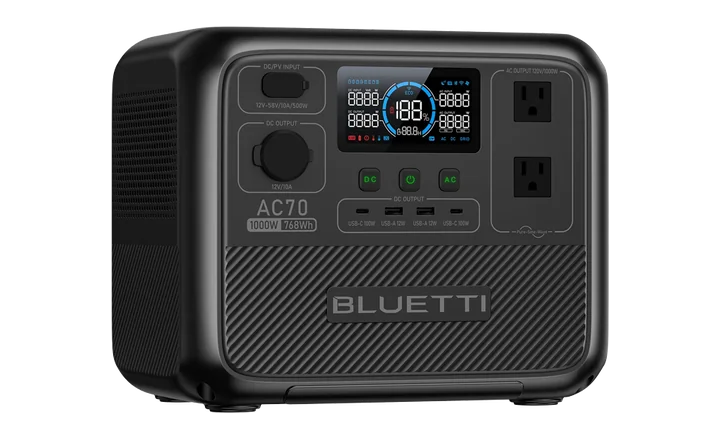
Once you want to keep food cold or run medical equipment overnight, step up to the 1,000-watt class. The AC70 puts out 1,000W with 768Wh of storage, expandable if you need more, which will usually carry an efficient refrigerator for half a day to a full day alongside phones, lights and a router.
Multi-day outages and whole-home backup
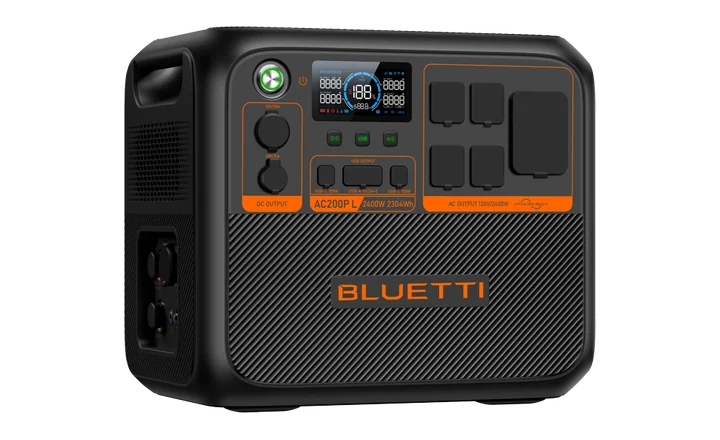
Long outages after a major storm are where capacity matters more than anything else. A larger home-backup unit like the AC200P L, at 2,400W and 2,304Wh, can run a refrigerator, medical equipment, a sump pump and lights at the same time. Running a typical fridge on its own, that capacity lasts roughly a day and a half to two days, and longer with a solar panel topping it up. If your region is on the wetter side of the El Niño map, or you have had multi-day outages before, this is the tier to plan around.
Recharging when the grid stays down
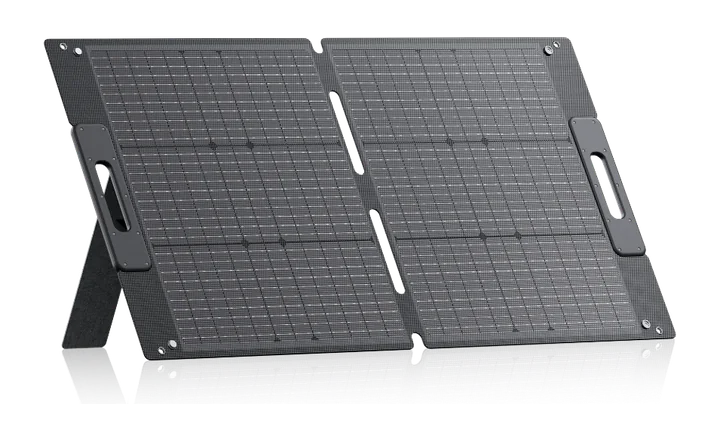
A battery is only as good as your ability to refill it. A foldable 100W solar panel puts a few hundred watt-hours back into a compatible station over a sunny day - not enough to run a house, but enough to keep phones, lights and a radio going indefinitely and to stretch a fridge across a longer outage. Pair one with whichever station you choose.
If your region is trending wetter: flood preparation
For the Southwest, California, Texas, the Gulf Coast and the Southeast, the defining El Niño risk is water. It is rarely one dramatic storm; it is repeated systems over saturated ground, which is why so much El Niño flooding happens outside mapped flood zones. Start by looking up your address on FEMA's flood map and your county's emergency site, then walk your property after the next rain to see where water actually pools.
- Clear gutters, downspouts, drains and any storm channel on or near your lot before the season, and again after the first big storm.
- If you live below a hillside or a recent burn scar, treat debris flow as a real possibility and know your evacuation route now.
- Move irreplaceable documents, photos and electronics off the floor and out of the basement.
- Check your insurance: standard homeowners policies do not cover flooding, and flood policies typically have a 30-day waiting period.
Gear-wise, the priorities are keeping water out of the doors and out of the basement. Reusable barriers go down in minutes and store flat, unlike a pile of sand. If you have a sump pump, the failure mode to plan for is the power going out in the middle of the storm, which is exactly when a battery-backup pump earns its price. Leak sensors are cheap and will wake you up before the damage starts.
If your region is trending drier: fire, smoke and water supply
For the Pacific Northwest, the northern Rockies, the Great Lakes and the northern tier, an El Niño winter is usually the quiet one - milder, drier, less snow. The problems show up later: a thin snowpack means tighter water supply in spring and summer and an earlier, longer wildfire season, so the preparation is about the months after the winter rather than the winter itself.
- Build defensible space now, while it is cool: clear dead vegetation and anything flammable within five feet of the house.
- Plan for smoke as much as for flame. Even far from a fire, weeks of poor air quality are the more likely impact, and they hit children, older adults and anyone with asthma hardest.
- Expect drought restrictions on outdoor watering by summer and reduce reliance on it now.
- Sign up for your county's wildfire and evacuation alerts, not just the weather service.
The gear here is about air and the first sixty seconds of a fire. N95 respirators are the only masks that meaningfully filter smoke particles. A HEPA purifier sized for the room you sleep in makes smoky weeks tolerable. And a basic ABC extinguisher in the kitchen and garage is worth more than any of it if a small fire starts at home.
A simple timeline
The 2026 event is forecast to peak around Nov 2026 – Jan 2027, with the strongest effects on U.S. weather usually running from December through March. Working backward from that:
This week
- Turn on National Weather Service alerts on your phone and sign up for your county's emergency notifications.
- Store water and check the first-aid kit and medications.
- Decide how much backup power you need using the sizing steps above.
This month
- Buy the power station and any region-specific gear, then actually charge it and test it once.
- Clear gutters and drains, or build defensible space, depending on your side of the map.
- Review insurance coverage while there is still time for any waiting period to pass.
Before the peak
- Top off the power station and fuel the car before each forecast storm system.
- Stage flood barriers or evacuation bags where you can reach them in the dark.
- Re-check your local page as the season goes on: the forecast, alerts and checklist there update with conditions.
Frequently asked questions
How much water should I store for an El Niño winter?
The standard planning figure is one gallon per person per day, with a minimum three-day supply and two weeks if you have the space. That covers drinking and basic sanitation. Count pets, and add more if anyone in the household is pregnant, ill, or in a hot climate.
Can I run a portable power station indoors?
Yes. Battery power stations produce no exhaust, so they are safe to use inside an apartment or house. That is the key difference from gas generators, which must never run indoors, in a garage, or near an open window because of carbon monoxide.
How big a power station do I need to run a refrigerator?
A typical full-size refrigerator draws roughly 100 to 200 watts while the compressor runs and cycles on and off, using on the order of 1 to 1.5 kilowatt-hours over a day. A unit in the 700 to 1,000 watt-hour class will usually carry an efficient fridge for half a day to a full day; a larger home-backup unit, or adding a solar panel to recharge, is what gets you through multi-day outages.
Do I need sandbags if I am not in a mapped flood zone?
Not always, but El Niño winters cause a lot of flooding outside official flood zones because the ground is saturated by repeated storms. If water has ever pooled at your doors, garage, or on the downhill side of your lot, or you live below a hillside or a recent burn scar, a set of reusable barriers is cheap insurance.
When should I have everything ready by?
El Niño impacts on U.S. weather are usually strongest from December through March, and the 2026 event is forecast to peak around Nov 2026 – Jan 2027. Aim to have the basics stocked by late fall, before the first big storm systems, and use the calmer stretches in between to finish the rest.
Your local page has the specific hazards, live weather and alerts, and a preparation checklist that saves your progress.